Hyunseok Lee (이현석) at Haein Art Project

Haeinsa Temple is hosting its first contemporary art exhibition, involving 34 artists from 10 countries, to commemorate the millennial anniversary of the Tripitaka Koreana, which UNESCO has designated one of the “most important and most complete corpus of Buddhist doctrinal texts in the world.”

Among the 34 international artist in the exhibition is Hyunseok Lee, who is contributing a 10 minute video work entitled 1,000 years.
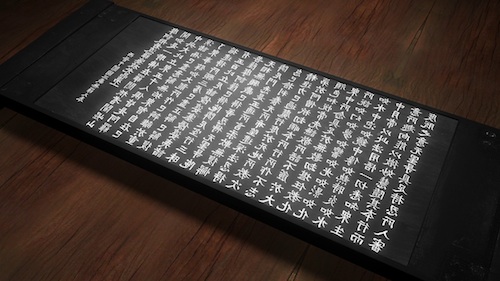
Lee Hyun-seok: Still image from 1,000 Years (2011) - 10 minute video work

Lee comments:

This artwork, 1,000 years, represents the 1,000 years of the Tripitaka Koreana and the 1,200 years history of the Haeinsa monastery through the digital images artwork in order to deliver the historic and religious meaning of the Tripitaka Koreana and Haeinsa itself.

Particularly, I have focused on exploring the representation of Buddhist philosophical principles and sacred experience by dramatising abstract and surreal environments displaying Korean architecture and the Tripitaka Koreana. This encourages audiences to feel the ‘sacredness’ which is a unique and indigenous form of Korean tradition. The Buddhist style of narration hopefully will evoke a dramatic feeling to explore the holistic passion and pride about the Tripitaka Koreana. The English voiceover also will deliver the deep meaning of the Korean Buddhism to people from all over the world.

This form of art work, using the ‘Animated Spiritual Documentary’ genre, explores the beauty of the physical outlook as well as the metaphysical meaning using the both realistic and surreal expression based on my subjective and artistic interpretation to share the ‘feeling’ with audiences.

通 | 통 | Tong
Date: Sept 23, 2011 – Nov 6, 2011 (45 days)
Organizer: Haein Art Project
Host: Haeinsa Temple
Curators: Yu Yeon Kim(Chief), Jiwoong Yoon
Advisors: Gerardo Mosquera, Martin Brauen
Venue: Haeinsa Temple, Hapcheon, Korea
Haein Art Project: 44-1 Chiin-ri, Gaya, Hapcheon, Gyeongsangnam-do, South Korea, (678-895)
TEL: 055-934-3175 (English); 055-934-3173 (Korean); Fax 055-934-3174
Web: www.haeinart.org Email: pr.haeinart@gmail.com

KAYA in concert at the KCC

KAYA Concert: ‘Bridge’

Harmony of Korean traditional harp ‘kayagum’ and guitar
Korean Cultural Centre UK: Multi Purpose Hall
Friday 21st October 2011 7pm – 8:30pm
Register via info@kccuk.org.uk | 020 7004 2600

Kaya

The team name ‘KAYA’ derives from the Korean traditional instrument ‘kayagum’. Ji Eun Jung plays the modern 25 string kayagum with Sung Min Jeon playing acoustic guitar. They’ve been performing together since 2002 in Korea and since 2005 in Europe after they settled in UK. They’ve performed for various diplomatic, corporate, cultural and charity events including at London City Hall, British Museum, Asia House, Oxford University, Chelsea Flower Show. They were often invited to perform to represent Korea, and also stand for the harmony between the East and the West, and the bridge between Korea and the world. They’ve released two CDs: ‘Bridge’ and ‘Korean Breeze’ in UK. Official website: www.kaya-music.co.uk

Ji Eun Jung

Ji Eun Jung is a professional kayagum player and a national initiator of the Important Intangible Cultural Assets of Korea, No.23 Jook Pa Kim Sanjo. She did her BA in Korean Traditional Music at Ewha Woman’s University and MA in Asian Music at Dong Gook University. After graduate she had performed all over the world.

Sung Min Jeon

Sung Min Jeon is a Korean guitarist and folk singer songwriter. He mainly plays a steel string acoustic guitar with a harmonica. He started playing the guitar when he was 13. His passion for music was inspired by his family. His father plays various instruments and is also a great singer, while his mother used to run a record shop. His uncle is the leader of the greatest Korean folk duo, ‘Sunflower’.

Program

1. Sanjo
Sanjo, Korean representative music for solo instruments, was developed in the 19th century. It is thought to have been developed from shinawi, a form of improvisation played in shamanistic ceremonies in Jeolla Province, in the south western part of the Korean peninsula. Originally, Sanjo was improvised music but now the forms are set. It has five movements which increase in tempo Chinyangjo, Chungmori, Chungjungmori, Chajinmori and Hwimori.

2. Amazing Grace
‘Amazing grace’ is a hymn written by English poet and clergyman ‘John Newton’ (1725-1807). It is one of the most recognizable songs in the world. Ji Eun Jung tries to arrange the song to fit 25 strings Kayagum.

3. Thinking of you
Sung Min composed ‘Thinking of You’ inspired by one rainy day when he thought of someone he loves.

4. Heart for the people
This is Ji Eun’s own composition. As is well known, her home country Korea has been divided into North and South for more than 50 years. In the face of such geographical and ideological division, she believes the most important thing is to continue to love the people who are suffering.

5. Your theme
In Ji Eun’s composition ‘Your Theme’, she intends listeners to let their feelings roam freely inspired by the emotion of the music.

6. Dokdo
Sung Min’s composition ‘Dokdo’ was inspired by Dokdo, the island of the Korean coast in the East Sea. It literally means ‘Solitary Island’ in Korean. It’s a small but beautiful island. Also Dokdo is special and means a lot to Koreans. It’s in every Korean’s heart.

7. Market day / People of the sea / The field – ‘Home’
With photo slide show of Ji Eun’s father Jung Hoi Jung’s photo works – Korean rural scenery in 1970’s
Ji Eun composed and arranged ‘Market day’ and ‘People of the Sea’ inspired by the photos taken by her father, Mr. Jung Hoi Jung, a professional photographer. His photos show scenes of Korea in 1970s. ‘Home’ is Sung Min’s composition.

8. The narrow way
‘The Narrow Way’ is Ji Eun’s own composition and words. There are many ways in our life, but she believes that the true way of life is narrow.

9. New Arirang
Joined by daegum, the traditional Korean bamboo flute, and keyboard
‘Arirang’, is the most representative Korean traditional folk song. ‘Arirang’ is an ancient native Korean word. ‘Ari’ means ‘beautiful’ and ‘rang’ can mean ‘dear’. Ji Eun arranged ‘Arirang’ into a modern style.

Francesca Cho: “This is not just a picture” at Mayfair Library

Francesca Cho participated in a group exhibition entitled “Free Words” in the Mayfair Library three years ago. She returns to the same venue with a solo show this month:

This is not just a picture

Mayfair Library Exhibition Hall
25 South Audley Street
London W1K 2PB
October 14th – November 5th
11am – 7pm Monday – Friday
10.30am – 2pm Saturday

Francesca Cho: This is not a picture
Francesca Cho: Untitled (2011). Oil and ash on canvas, 91 x 71 cm

The title of the exhibition ‘This is not just a picture’ is a reference to the involved process that Francesca Cho employs when creating her work namely, painting with a mixture of ash and paint.

The ash is produced by burning former belongings e.g. old photos, letters, catalogues, paintings or drawings, legal documents and papers which showed the artist’s name and address. The presence of unforgettable stories within the ash is now embedded in the paint of Cho’s canvasses.

Ash is a symbol of mortality. The beautiful images created therefore are not just aesthetic, but are also an expression of her emotional response to everyday tragedies in the news and her desire to transform this into something more positive. In doing so they become cathartic.

‘Opening Performance’ at 7.30pm
In their performance art collaboration entitled: Elasticized Probation, Part I, Francesca Cho and Dagmar Glausnitzer-Smith will explore an “intertransitexchangecommunication” an experiment between sound, voice and object. Cho’s words are from the sources of SIJO – Korean traditional poetry – and their foreign-ness will meet with Glausnitzer-Smith’s sounds of everyday objects. The artists move within the boundaries of their own individual entity, however are deceivingly connected.

Curated by Camille Rodskjaer

www.francescacho.com

KTO logos

Eunjung Seo Feleppa (painter)

Eunjung Seo

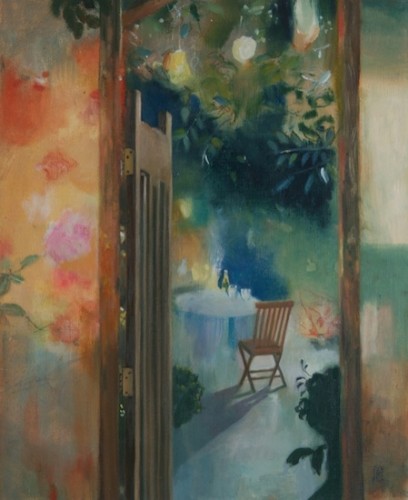
I was born in South Korea and have painted all my life. I studied Fine Art at Hong-Ik University in Seoul and since then, I have spent my time roughly 50:50 between England and Korea, such to the point that I feel like I live in two different worlds. To me, Korea is my Narnia. Then, when I’m in Korea, England is my Narnia, so I always miss the other side. This might be the reason why I paint windows and doors as metaphors. When you try to think about the other side, you can’t remember quite clearly about what’s there, so you visualize dream-like images. This dream-like, nostalgic other side is what everyone has in them, and is the reason why we go to the cinema, galleries, and concerts – does art reminding us of our dreams?

I wanted to represent this other side – a somewhat indescribable, melancholy and nostalgic place where language or logic can’t enter. These images combine a strange time and place, which makes you think about a familiar or specific moment.

  • BFA (Hons) Hong-Ik University, Seoul
  • Group Exhibition, Highgate Fine Art
  • Solo Exhibition, Gallery PFO, Busan
  • 2006 Solo Exhibition, M Gallery, Busan Museum of Modern Art, Busan
  • 2012 Currently studying Post Compulsory PGCE at Institute of Education

www.saatchiart.com/eunjungseo

Jee Soo Shin in Oze escapade series 1 – 3

Oze

O:Ze is created by two composers who specialise in contemporary music. The primary interest of the group is to embody compositions that contain visual and spacial elements and to give platform for performances of such works, which are mostly ill-fitted in a traditional concert venue. The name O:Ze comes from the french verb oser.

The Seoul-Foundation-of-Arts-and-Culture-funded inaugural event will take place on the 8th of October in Seoul Art Space Mullae, where acoustic avant-garde will be showcased and given chance for a wider audience. O:Ze also aims to engage in collaborative projects with visual artists and dancers to create a pool of multi-disciplinary artists, and to explore the meaning of music performance in a contemporary society.

Co-executive, project coordinator, web editor, translator and composer Jee Soo Shin studied piano and composition during her middle- and high-school days at Sun-Hwa Art School, and BA in composition at Seoul National University. During her study at the university, she performed many of her pieces at various concerts in Korea, including the New Artists’ Concert held in Sejong Arts’ Centre in Seoul. She studied composition and music theory at the University Mozarteum in Salzburg and won a Raiffeisen-Klassik-Preis in 2004. She finished her studies in 2006 with distinction, which lead her to win a Bernhard-Paumgartner Medal. Her works have been performed in Korea, Austria, Switzerland, Serbia, United Kingdom and South Africa.

Jee Soo Shin is awarded PhD at University of Southampton from her study with Michael Finnissy. Her works can be heard at www.jisushin.com.